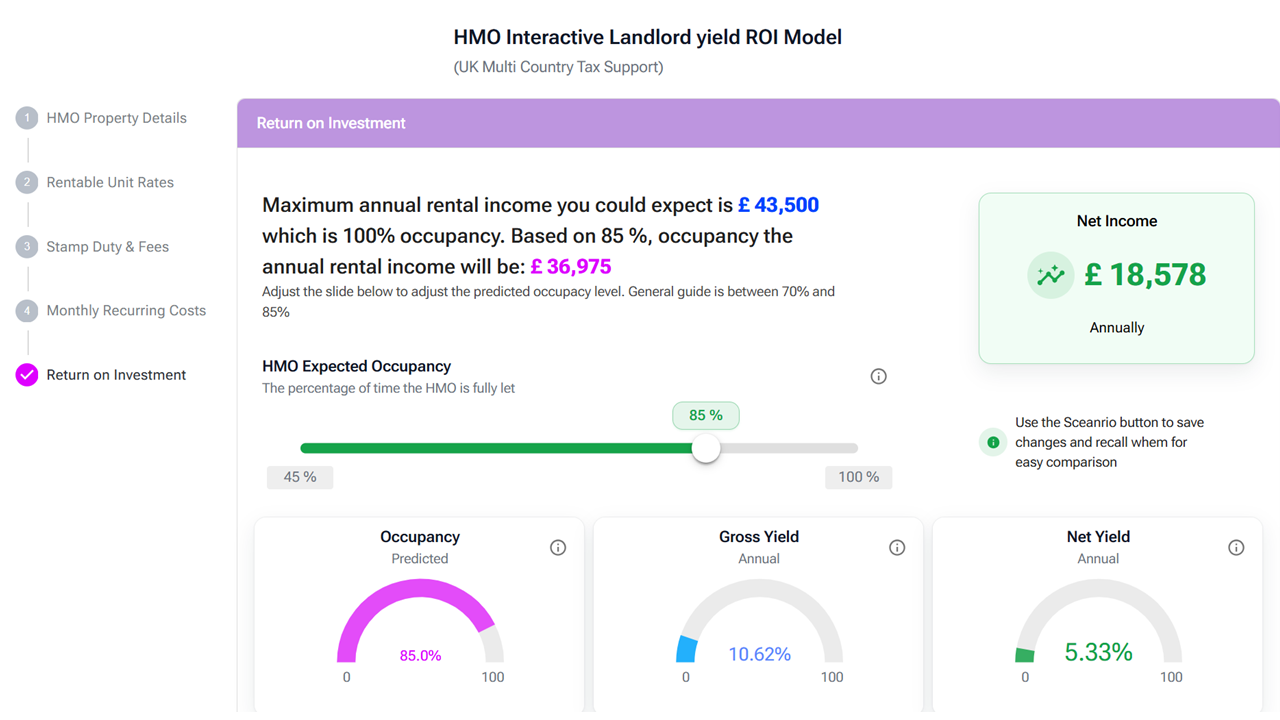
What Is an HMO Rental Yield Calculator?
An HMO Rental Yield Calculator helps property investors estimate the financial performance of a house in multiple occupation before committing capital to a purchase.
HMO investments can generate higher rental income than single-let properties, but they also involve more complex costs, regulation, operating assumptions, and regional tax treatment.
This calculator helps investors understand:
Gross rental income
Occupancy-adjusted income
Monthly operating costs
Net monthly income
Gross yield
Net yield
Regional property purchase tax
One-off purchase costs
Refurbishment costs
Total capital required
Rather than relying on a simple rent-versus-property-price calculation, the model uses individual room rents, expected occupancy, operating costs, ownership type, purchase region, and acquisition costs to estimate investment performance.
Large HMOs may require a licence where 5 or more people from more than one household share facilities, and smaller HMOs may also require licensing depending on local council rules.
How This HMO Rental Yield Model Works
The calculator estimates HMO investment performance by modelling both income and cost.
It starts with the property purchase price, location, ownership structure, and number of rentable units. It then builds up expected rental income from each room or unit and adjusts this by an assumed occupancy rate.
The model also includes operating costs, property management fees, leasehold charges, refurbishment costs, and one-off purchase fees.
Purchase Region
The calculator allows the investor to select whether the property is in England, Scotland, or Wales.
This matters because property transaction taxes differ by region.
England uses Stamp Duty Land Tax, Wales uses Land Transaction Tax, and Scotland uses Land and Buildings Transaction Tax. Higher rates can apply to additional residential properties.
Property Purchase Price
The capital value is the price paid for the property.
This is one of the most important drivers of yield because it determines both the size of the investment and the likely property transaction tax due.
Number of Rentable Units
The model allows the investor to define the number of rentable rooms or units.
Each unit can have its own monthly rent assumption, making the model more accurate than using a single blended rent figure.
Room-Level Rental Values
The calculator models expected rent for each unit individually.
This is useful for HMOs because room values can vary depending on size, ensuite access, kitchenette access, furnishing level, and perceived tenant value.
Refurbishment Costs
The model includes optional capital expenditure for refurbishment or renovation work.
This helps investors understand the true capital required before the property becomes income-producing.
Vacancy During Renovation
Where refurbishment is required, the calculator also captures the expected renovation period.
This helps highlight that time spent preparing a property can delay income generation.
Operating Costs
The model includes recurring HMO operating costs such as:
Buildings insurance
Council tax
Cleaning
Gas and electricity
Water
Broadband
Maintenance
Other running costs
These costs are important because HMO gross income can look attractive, but net yield depends heavily on ongoing operating expenditure.
Property Management Fees
The calculator allows investors to model either self-management or a letting provider fee.
Professional HMO management can reduce operational workload but materially affects net income and net yield.
Occupancy Rate
The calculator adjusts projected income by expected occupancy.
This is critical because HMO returns are sensitive to void periods, tenant churn, seasonal demand, and local rental market strength.
Metrics Explained
Gross Income
Gross Income estimates the annual rental income before operating costs are deducted.
The calculator builds this from the monthly rent of each room or unit and adjusts it by the expected occupancy rate.
Monthly Gross Income
Monthly Gross Income shows the expected rental income in a typical month before recurring costs.
This helps investors understand the headline income potential of the property.
Monthly Costs
Monthly Costs estimate the recurring cost of operating the HMO.
This includes items such as management fees, ground rent, service charges, insurance, council tax, utilities, cleaning, broadband, and other running costs.
Net Monthly Income
Net Monthly Income estimates the remaining monthly income after recurring costs have been deducted from occupancy-adjusted rental income.
This is one of the most practical metrics for investors because it shows expected monthly cashflow before financing, tax, and personal circumstances.
Annual Net Income
Annual Net Income shows the projected yearly income after recurring operating costs.
This helps investors compare one HMO opportunity against another on a like-for-like annual basis.
Gross Yield
Gross Yield compares expected annual rental income with the total capital invested in the property and one-off purchase costs.
It provides a headline measure of rental return before recurring operating costs.
Net Yield
Net Yield compares annual income after recurring costs with the total capital invested.
This is usually the more useful yield metric because it accounts for the ongoing cost of operating the HMO.
Total Capital Outlay
Total Capital Outlay estimates the upfront investment required to purchase and prepare the property.
This includes the purchase price, regional property transaction tax, survey fees, legal fees, other one-off purchase costs, and refurbishment costs where applicable.
Property Transaction Tax
The calculator estimates the regional property transaction tax based on the selected purchase location.
This is important because England, Scotland, and Wales use different systems and rates, and additional property rules can materially increase upfront costs.
Why Net Yield Matters
Gross yield is useful for quickly comparing properties, but it can overstate the attractiveness of an HMO investment.
HMOs often involve higher operating costs than single-let properties. Investors may need to account for utilities, council tax, broadband, cleaning, maintenance, management fees, licensing requirements, and compliance costs.
Net yield gives a more realistic view of investment performance because it reflects the income left after recurring operating costs.
This calculator helps investors move beyond headline rental income and understand whether the property is likely to produce a sustainable return.
Who This Calculator Is For
HMO Property Investors
Estimate gross yield, net yield, income, and capital requirements before making an offer.
Buy-to-Let Landlords
Compare HMO returns against standard single-let investment opportunities.
Property Sourcers
Present more structured investment assumptions to prospective buyers.
Letting Agents and HMO Managers
Model income, management fees, operating costs, and occupancy assumptions.
Finance and Mortgage Brokers
Support conversations around rental income, affordability, and investment viability.
Property Consultants
Build clearer investor-facing business cases using property-specific assumptions.
Frequently Asked Questions
How is HMO rental yield calculated?
The calculator estimates annual rental income from the rentable rooms or units, adjusts this by occupancy, and compares it with the total capital invested.
What is the difference between gross yield and net yield?
Gross yield looks at rental income before operating costs. Net yield accounts for recurring costs such as management fees, utilities, insurance, service charges, council tax, cleaning, broadband, and maintenance.
Why does occupancy matter?
Occupancy affects how much rent is actually collected over the year. A property may have strong headline room rents, but void periods or tenant turnover can reduce realised income.
Does this calculator include stamp duty?
Yes. The model includes regional property purchase tax logic for England, Scotland, and Wales. These systems differ, so the selected region affects the estimated upfront cost.
Does an HMO need a licence?
A large HMO usually needs a licence where 5 or more people from more than one household share facilities. Smaller HMOs may also need licensing depending on local council rules.
Why are operating costs so important for HMOs?
HMOs often include costs that may not apply in the same way to single-let properties, such as inclusive utilities, broadband, cleaning, higher management complexity, and ongoing compliance-related costs.
Build a Stronger HMO Investment Case
Whether you are assessing a new HMO purchase, comparing investment opportunities, or modelling the impact of occupancy and running costs, this calculator helps estimate the true financial performance of a UK HMO investment.
Use the model to explore room-level rents, regional purchase costs, operating expenses, net income, and yield before committing capital.