New! LED Lighting Retrofit ROI | Calculator
Chart
Multi-Page
PDF Report
Estimate cost savings, payback period, ROI, NPV, TCO, and CO₂ emissions reduction from replacing traditional lighting with LED lighting across enterprise facilities.

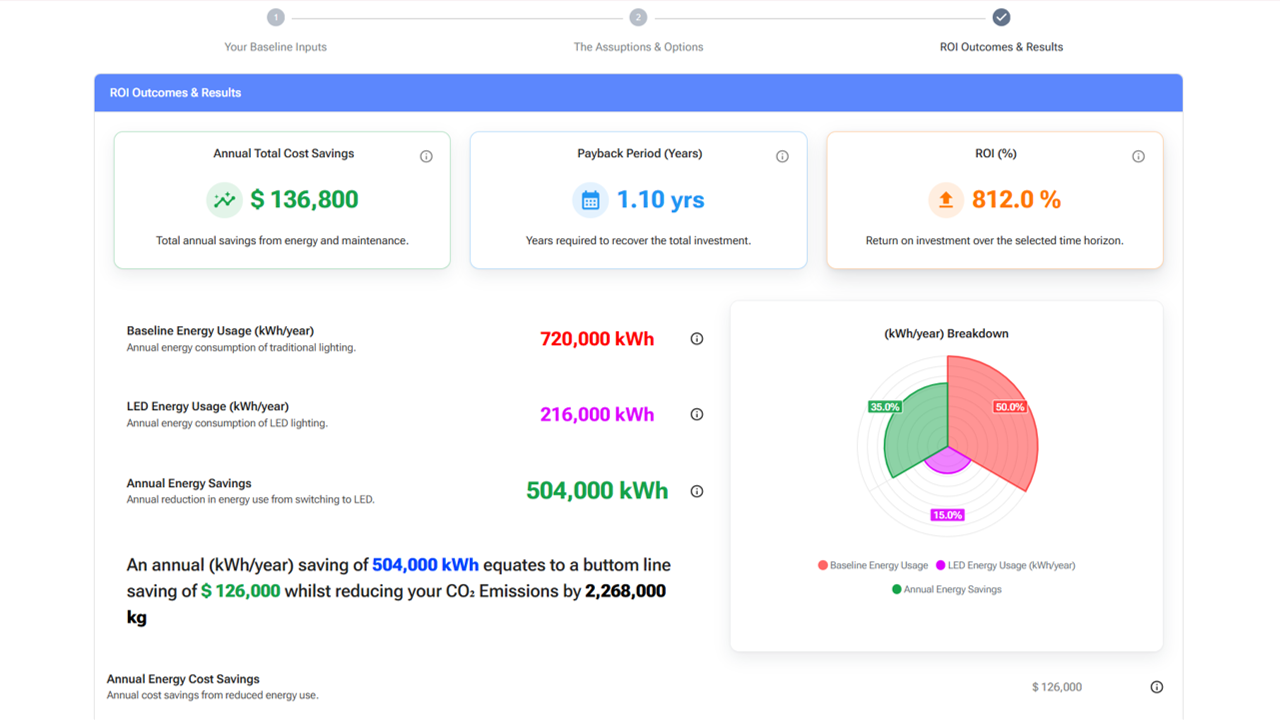
An LED Lighting Retrofit ROI Calculator helps organisations estimate the financial, operational, and environmental impact of replacing traditional lighting with energy-efficient LED fixtures.
Lighting upgrades can reduce electricity consumption, lower maintenance costs, extend fixture lifespan, and support sustainability targets. However, the business case depends on fixture count, wattage, operating hours, electricity prices, installation costs, and available incentives.
This calculator helps organisations understand:
Annual energy savings
Annual cost savings
Maintenance savings
Total upfront investment
Payback period
ROI over time
Total cost of ownership
Net present value
CO₂ emissions reduction
Rather than relying on generic energy-saving assumptions, the model uses your own lighting infrastructure, usage profile, and cost inputs to estimate the potential value of an LED retrofit.
The calculator compares the current cost of traditional lighting with the projected cost of LED lighting over a selected time horizon.
It models energy use, maintenance costs, installation costs, removal costs, tax incentives, and long-term financial value.
The model starts with the number of existing traditional fixtures to be replaced.
This determines the scale of the project and directly affects energy use, replacement costs, installation costs, and savings potential.
The wattage of the current fixtures is used to estimate baseline energy consumption.
Higher-wattage fixtures usually create a stronger savings opportunity when replaced with lower-wattage LED alternatives.
The planned LED wattage is used to calculate the future energy requirement.
The difference between existing wattage and LED wattage is one of the main drivers of annual energy savings.
The calculator uses hours per day and days per year to estimate annual usage.
Lighting systems used for longer hours, such as warehouses, offices, factories, retail sites, hospitals, and car parks, often produce stronger retrofit economics.
The cost per kilowatt-hour is used to convert energy savings into financial savings.
Higher electricity prices increase the value of reducing energy consumption.
The model compares traditional fixture maintenance intervals with LED fixture lifespan.
This helps estimate how much could be saved through fewer replacements, reduced labour, and lower ongoing maintenance requirements.
The model includes:
LED fixture cost
Installation cost
Removal and disposal cost
Tax incentives or rebates
This gives a clearer view of the true initial investment required.
The calculator also includes a selected investment period and discount rate.
These inputs support longer-term investment analysis, including total cost of ownership and net present value.
Baseline Energy Usage estimates how much electricity the existing lighting system consumes each year.
This provides the starting point for comparing the current system with the proposed LED system.
LED Energy Usage estimates the annual electricity consumption of the new LED fixtures.
This allows organisations to compare the future lighting energy requirement against the existing baseline.
Annual Energy Savings shows the reduction in electricity use created by switching to LED lighting.
This is one of the core operational benefits of the retrofit.
Annual Energy Cost Savings converts the energy reduction into a financial saving using the electricity cost per kilowatt-hour.
This shows the annual reduction in electricity spend.
Annual Maintenance Savings estimates the reduction in replacement and maintenance costs from using longer-life LED fixtures.
This is important because LED retrofit value is often driven by both energy savings and maintenance savings.
Total Upfront Investment estimates the initial project cost after accounting for LED fixture costs, installation, removal, disposal, and any incentives or rebates.
This is the investment figure used to assess payback and ROI.
Annual Total Cost Savings combines energy cost savings and maintenance savings.
This provides a single annual benefit figure for the LED retrofit project.
Payback Period estimates how many years it may take for annual savings to recover the upfront investment.
This helps finance and facilities teams understand how quickly the project could pay for itself.
ROI estimates the return generated over the selected time horizon compared with the initial investment.
This helps compare the lighting retrofit against other capital projects.
Total Cost of Ownership compares the long-term cost of continuing with traditional lighting against the projected cost of switching to LED.
This helps show the full financial impact across the selected period, not just first-year savings.
Net Present Value estimates the value of future savings in today’s terms after applying a discount rate.
This is useful for finance teams evaluating whether the retrofit creates long-term economic value.
CO₂ Emissions Reduced estimates the carbon impact of using less electricity over the selected time horizon.
This helps connect the financial business case with sustainability and ESG objectives.
Energy cost is often one of the most visible benefits of an LED lighting retrofit.
When a large number of fixtures operate for many hours each year, even a modest reduction in wattage can create significant annual savings.
However, the strongest business case usually comes from combining:
Lower electricity consumption
Reduced maintenance frequency
Longer fixture lifespan
Lower replacement costs
Available rebates or tax incentives
Reduced carbon emissions
This calculator helps organisations model those factors together, rather than looking at energy savings in isolation.
Estimate the operational and maintenance impact of replacing existing lighting with LEDs.
Assess retrofit projects across multiple buildings, floors, or facilities.
Evaluate payback, ROI, total cost of ownership, and net present value.
Estimate energy reduction and CO₂ emissions avoided.
Build structured business cases for lighting upgrade projects.
Understand the financial impact of improving building efficiency.
The calculator compares total savings over the selected time horizon with the upfront investment required for LED fixtures, installation, and removal.
The biggest drivers are usually existing fixture wattage, LED wattage, number of fixtures, operating hours, electricity cost, and maintenance assumptions.
The more hours the lights are used, the greater the potential energy saving from switching to lower-wattage LED fixtures.
Yes. The model compares traditional maintenance costs with LED maintenance costs based on fixture lifespan and replacement assumptions.
Payback period shows how long it may take for the project’s annual savings to recover the upfront investment.
Energy-efficient lighting reduces electricity consumption, which can lower associated carbon emissions and support sustainability reporting.
Whether you are planning a lighting retrofit across one building or multiple facilities, this calculator helps quantify the financial and environmental impact using your own assumptions.
Use the model to estimate energy savings, maintenance savings, payback period, ROI, total cost of ownership, and CO₂ reduction before committing to an LED upgrade project.