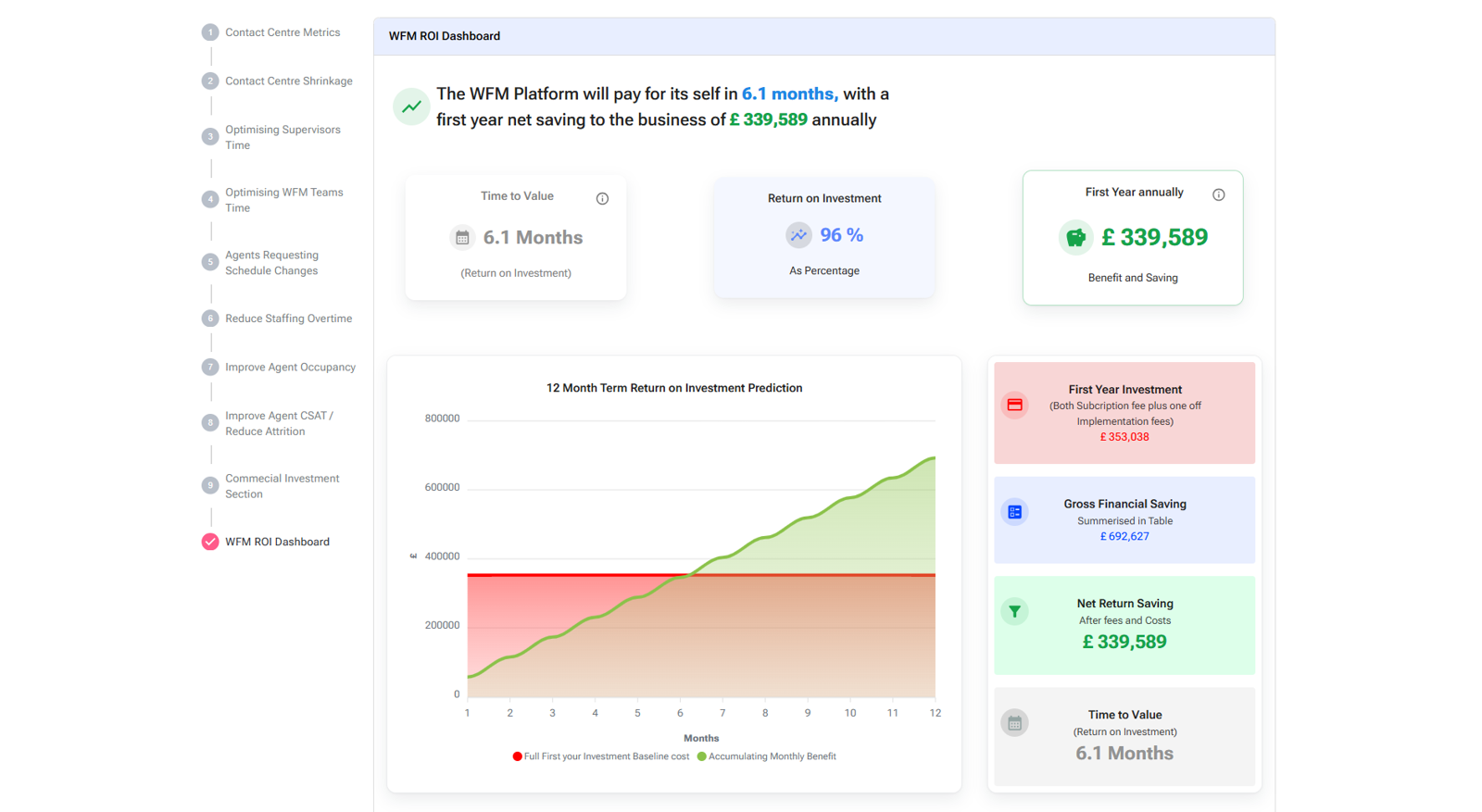
What This ROI Model Helps You Quantify
This ROI model helps contact centre and workforce management leaders quantify the operational and financial impact of workforce inefficiencies across scheduling, shrinkage, intraday management and manual supervisor effort.
Rather than relying on broad assumptions, this model enables organisations to understand where productive capacity is being lost, identify recoverable hours and build a financially credible business case for workforce optimisation initiatives. It translates operational inefficiencies into measurable outcomes including time savings, cost reduction, reclaimed FTE capacity and productivity improvements.
Why Contact Centre Workforce Efficiency Matters
Contact centres operate in a highly constrained environment where labour costs represent one of the largest operational expenses. Small inefficiencies across scheduling, staffing, shrinkage and workforce planning can compound quickly across hundreds or thousands of employees.
Poor visibility into workforce productivity often results in:
- Excess overtime costs
- Inefficient schedule management
- Reduced agent productivity
- Supervisor time lost to manual coordination
- Workforce planning inefficiencies
- Overstaffing or understaffing risks
This ROI model helps quantify those hidden operational costs and surfaces areas where automation, workforce management and employee engagement initiatives can recover lost productivity.
Workforce Productivity Is More Than Occupancy
Many organisations focus heavily on occupancy, but occupancy alone does not represent true productive capacity.
This model distinguishes between:
Occupancy — the percentage of time agents spend handling customer-related activity.
Utilisation — the broader measure of productive working time after internal and external shrinkage factors are considered.
Understanding this distinction helps organisations better model staffing requirements and uncover hidden inefficiencies that impact service performance and cost-to-serve.
Understanding Contact Centre Shrinkage
Shrinkage represents the time agents are unavailable to handle customer interactions despite being paid.
This model calculates both external shrinkage and internal shrinkage to provide a more accurate view of true productive capacity.
External Shrinkage
External shrinkage refers to planned or unplanned absences outside normal operational activity.
Typical examples include:
- Annual leave
- Public holidays
- Sickness absence
- Absenteeism and lateness
These factors directly reduce available staffing capacity and influence workforce planning assumptions.
Internal Shrinkage
Internal shrinkage refers to paid time where agents are unavailable for customer handling due to operational activities.
Examples include:
- Training and coaching
- Team meetings and one-to-ones
- Breaks and rest periods
- System downtime
- Administrative activities
While necessary, these activities reduce available handling time and often have a significant impact on operational efficiency when not accurately modelled.
Supervisor & Workforce Management Productivity
Supervisors and workforce planning teams spend significant time managing schedule changes, monitoring intraday demand and responding to operational disruption.
This ROI model helps quantify:
Supervisor Time Spent Managing Schedules
Manual schedule changes, holiday requests, overtime management and staffing adjustments create operational overhead for frontline leaders.
The model estimates the annual effort required for these activities and highlights opportunities to reduce administrative burden while freeing supervisors to focus on coaching and performance improvement.
Intraday Management Effort
Real-time demand monitoring and staffing adjustments are essential for maintaining service levels, but often consume a significant amount of supervisor time.
This model quantifies the annual effort involved in monitoring demand fluctuations and evaluates the potential efficiency gains from improved workforce management capabilities.
Workforce Planning & Forecasting Efficiency
Resource planners and workforce management teams spend considerable effort forecasting demand, managing schedules and responding to intraday changes.
The ROI model helps organisations estimate the productivity impact of streamlining these workflows while quantifying recoverable capacity across workforce planning operations.
Key Outcomes This ROI Model Helps Quantify
This model is designed to help organisations understand the financial impact of workforce optimisation initiatives through measurable business outcomes, including:
- Recoverable productive hours
- Reclaimed FTE capacity
- Reduced administrative workload
- Supervisor productivity improvements
- Reduced overtime dependency
- Workforce planning efficiencies
- Annual cost savings potential
- Faster financial payback justification
Rather than focusing on assumptions alone, the model enables organisations to build a credible, data-driven business case for operational improvement and workforce optimisation investment.
Who Should Use This ROI Model?
This ROI model is designed for organisations looking to improve workforce efficiency, reduce avoidable labour costs and better understand operational productivity.
Typical stakeholders include:
Contact Centre Leaders
To understand staffing efficiency, operational performance and hidden productivity loss.
Workforce Management Teams
To model scheduling efficiency, shrinkage and forecasting improvements.
Operations & Finance Leaders
To quantify financial impact and support investment decisions.
Enterprise Sales Teams
To build deal-specific business cases that connect operational improvements to measurable financial outcomes.